Inquiry
Form loading...

What Are the Top 10 Trade Exhibition Stands?

A great exhibition stand does more than look polished. It gives visitors a clear reason to pause, step inside, and start a conversation. As marketing author Seth Godin puts it, “People do not buy goods and services. They buy relations, stories, and magic.” That idea matters on a crowded show floor, where a bright backlit wall may catch the eye but a useful demonstration can earn someone’s time.

This guide explores ten types of Trade Exhibition Stands, from modular systems that fit neatly into a van to custom builds with meeting areas and carefully lit product displays. Each option has trade-offs. A compact pop-up stand may be easy to transport, yet offer little room for private conversations. A larger custom design can make a strong impression, but it needs more planning, budget, and setup time. There is no single winner for every exhibitor.

The ranking considers visual impact, practical use, flexibility, and the visitor experience. Look for specific details: readable graphics from the aisle, uncluttered counters, accessible storage, and lighting that shows products clearly without creating glare. Small things count. A stand can photograph beautifully and still feel awkward in person; that is worth remembering when comparing examples. The aim is not to copy the most dramatic design, but to find a stand that fits your goals, space, team, and audience.
What Are the Top 10 Trade Exhibition Stands?

What Defines a Trade Exhibition Stand?

A trade exhibition stand is a temporary, purpose-built space where an organisation presents its work and meets visitors. It includes more than walls and graphics. Its layout, lighting, display fixtures, and staff all shape how people experience the space. A well-defined stand makes its purpose clear from the aisle, then gives visitors room to pause, ask questions, and examine products or materials.

The details matter. A counter placed too close to an entrance can create a bottleneck, while harsh lighting may make printed information harder to read. Good planning considers visitor flow, sightlines, storage, accessibility, and the practical needs of the team working there. Keep key messages brief. Let visitors explore. Materials should suit the event’s duration and transport requirements, not just look appealing in a render. Even a carefully measured design can feel cramped once people arrive; that is worth acknowledging during planning. A stand is not defined by size alone, but by how effectively its physical setting supports clear communication and useful conversations.


How Trade Exhibition Stands Are Evaluated

A trade exhibition stand should be judged by how well it serves visitors, not by appearance alone. Reviewers can begin with clear objectives: product demonstrations, qualified conversations, or brand awareness. Then check whether the layout supports them. Can visitors spot the entrance, understand the main message, and reach a staff member without squeezing past a counter? Small details matter. A cable across a walkway can undermine an otherwise polished display.

Function deserves close inspection. Test lighting on printed graphics, check that screens remain readable in bright halls, and confirm storage does not spill into visitor areas. Measure accessible routes and turning space rather than relying on photographs. Staff should be able to demonstrate products comfortably and speak without competing with excessive noise. These checks are practical, but imperfect: hall conditions and visitor flow can change during an event. That is worth noting.

A useful evaluation also compares cost with likely outcomes. Record visitor conversations, demonstration attendance, and follow-up quality, then assess them against the stand’s goals. Don’t treat raw foot traffic as proof of success. Build quality, reusable materials, setup time, and clear safety procedures also affect value. A visually striking feature may attract attention yet block sightlines; it may need adjustment. The best assessment combines observation, measurements, and honest feedback from staff and visitors.

What Are the Top 10 Trade Exhibition Stands? — How Trade Exhibition Stands Are Evaluated

This is a comparative planning guide, not a market-research ranking. The scores are editorial ratings using the same weighted framework for each stand type: visibility (30%), visitor access (25%), flexibility (20%), cost efficiency (15%), and build simplicity (10%). Each criterion is rated from 1 (low) to 5 (high); the weighted result is shown out of 5. Footprints are common planning examples, not fixed industry standards.

Rank Stand type Typical planning footprint Open sides / access Visibility Visitor access Flexibility Cost efficiency Build simplicity Weighted score Best suited to
1 Island stand 20 × 20 ft (6.10 × 6.10 m) or larger; size varies by event Four sides 5/5 5/5 3/5 2/5 2/5 3.85 / 5 Large exhibits, product demonstrations, and layouts designed to attract visitors from multiple aisles.
2 Modular stand Often planned in repeatable modules, such as 10 × 10 ft (3.05 × 3.05 m); configuration varies Depends on the assigned position 3/5 3/5 5/5 4/5 5/5 3.75 / 5 Exhibitors seeking reusable components that can be reconfigured for different event spaces.
3 Peninsula stand Common example: 10 × 20 ft (3.05 × 6.10 m); actual allocations vary Three sides 4/5 4/5 3/5 3/5 3/5 3.55 / 5 Displays that need broad aisle exposure and more room than a standard inline space.
4 Corner stand Common example: 10 × 10 ft (3.05 × 3.05 m); actual allocations vary Two adjacent sides 3/5 3/5 4/5 4/5 4/5 3.45 / 5 Smaller exhibits seeking two-direction aisle exposure without a large floor-space allocation.
5 Outdoor stand Variable; planned around the site, access requirements, and event rules Often multiple sides; determined by the site layout 5/5 4/5 2/5 2/5 2/5 3.40 / 5 Large equipment, vehicles, demonstrations, and displays that require open-air space.
6 Pavilion stand Variable; may combine several allocated spaces into one coordinated area Depends on the pavilion plan 5/5 5/5 2/5 1/5 1/5 3.40 / 5 Multi-part showcases or collective presentations that need coordinated design and visitor flow.
7 Double-decker stand Usually a larger, project-specific footprint; upper-level construction requires venue approval Varies; access is typically concentrated at the ground level 5/5 4/5 2/5 1/5 1/5 3.15 / 5 Exhibitors needing additional meeting or presentation space above the main display area.
8 Custom-built stand Made to the allocated space; dimensions depend on the design and venue regulations Designed for the assigned position 5/5 4/5 2/5 1/5 1/5 3.15 / 5 Exhibits requiring a distinctive layout, tailored structures, or integrated demonstration areas.
9 Inline (row) stand Common example: 10 × 10 ft (3.05 × 3.05 m); deeper or wider spaces are also used One front side 2/5 2/5 4/5 5/5 5/5 3.15 / 5 Compact displays, first-time exhibitors, and layouts prioritizing straightforward setup.
10 Portable pop-up stand Display walls are often about 8–10 ft (2.44–3.05 m) wide; total space depends on the event allocation Usually one front side; varies by placement 2/5 2/5 4/5 5/5 5/5 3.15 / 5 Small displays and exhibitors who need a lightweight system that can be transported and assembled easily.

The Top 10 Types of Trade Exhibition Stands

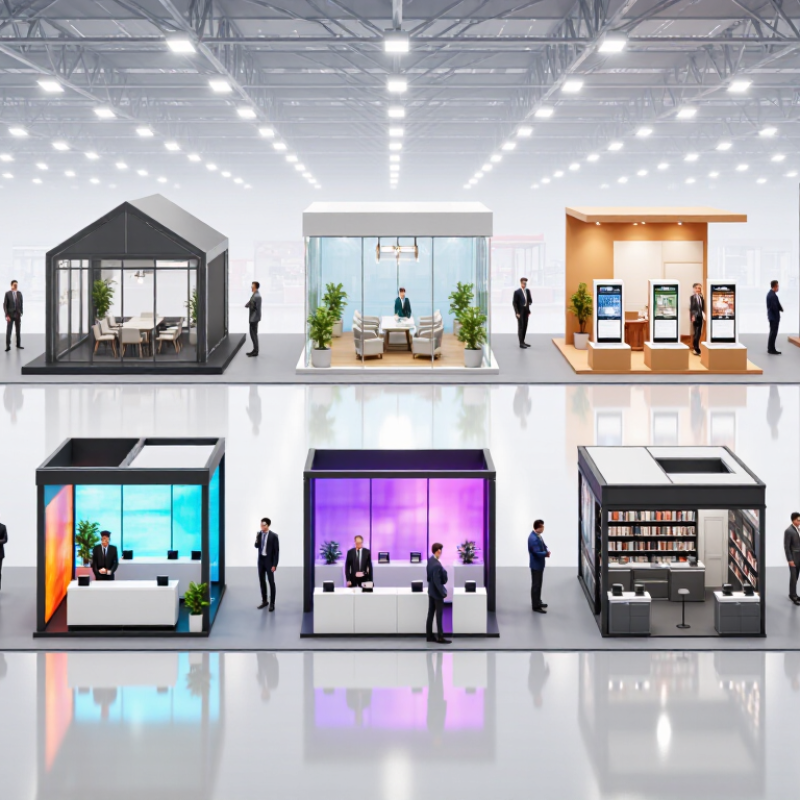
Trade exhibition stands come in many forms, and each suits a different space or goal. The ten common types are inline, corner, peninsula, island, modular, pop-up, portable, custom-built, double-decker, and outdoor stands. Inline stands fit along one aisle and often suit smaller budgets. Corner stands gain an extra open side. Peninsula and island layouts invite visitors from several directions. Some are simple.

Modular stands use reusable frames and panels, while pop-up and portable stands prioritize quick setup and transport. Custom-built displays allow precise layouts, but can take more planning. Double-decker stands add meeting space above the floor, though they need careful access planning. Outdoor stands need stable structures and materials suited to changing weather. A polished design is not always the most effective one; a narrow entrance or cluttered counter can still put people off. The right choice depends on booth dimensions, staffing, storage, and how visitors should move through the space.

Tips: Sketch visitor flow before choosing a layout. Leave clear paths, place readable signs at eye level, and test lighting on sample graphics. Ask the venue for height and setup requirements early. Measure twice; overlooked details happen.

Key Features and Uses of Each Stand Type

What Are the Top 10 Trade Exhibition Stands?
Key Features and Uses of Each Stand Type

An inline stand opens on one aisle and suits focused product displays or smaller budgets. End-cap stands face two aisles, giving compact teams more visibility and room for demonstrations. Peninsula stands open on three sides, making them useful for presentations and steady visitor flow. Island stands welcome visitors from every direction and fit larger launches, though they need careful staffing. Modular stands use adaptable components; teams can reconfigure them for different floor plans. A clean layout matters more than extra panels.

Portable pop-up stands are lightweight and quick to assemble, ideal for brief events or simple backdrops. Tabletop stands fit small footprints and work well for samples or one-to-one conversations. Custom-built stands can match specific products and visitor journeys, but often require more planning. Double-decker stands add meeting space above the floor, where venue height and access matter. Outdoor stands use weather-ready structures for open-air shows; wind can still complicate setup. CEIR attendee research commonly reports that 81% of trade show attendees have buying authority. That makes clear demonstrations and easy conversations valuable across formats. The figure is a broad benchmark, not a promise for every event. A striking stand can still feel empty if its purpose is unclear.

How to Choose the Right Exhibition Stand for Your Business

Choosing the right exhibition stand starts with a clear business goal. Are you launching a product, collecting leads, or arranging private meetings? The answer shapes your layout, lighting, and display choices. A modular stand can adapt across different venues, while a shell-scheme stand may suit a tighter budget or a smaller space. Start with the job.

Next, measure the space and check what the venue provides. Note the stand dimensions, ceiling height, power access, and visitor routes. A tall display may attract attention, but it can block sightlines or feel cramped beside a busy aisle. Measure twice. Leave room for people to enter, pause, and speak without crowding the demo area.

Set a realistic budget that includes transport, installation, graphics, storage, and staff time—not just the stand itself. Choose durable materials if the stand will travel often, and keep key messages readable from several steps away. In practice, teams sometimes overfill their displays with text; it is an easy mistake to make. One clear headline, a working product sample, and a tidy counter may serve visitors better than another screen. Before booking, review a floor plan and ask the venue about practical restrictions. A stand that looks polished in a rendering can feel different under exhibition lighting.